

What was the CS2 skin market crash?
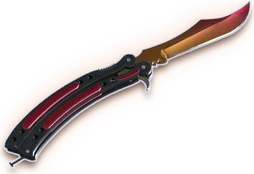
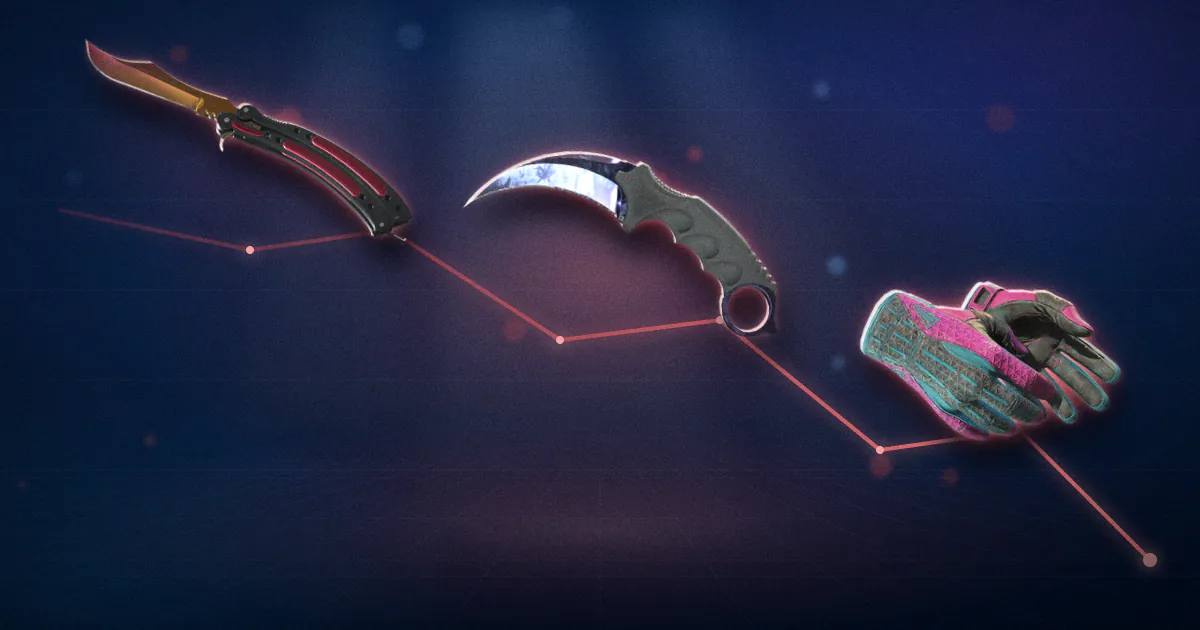
The CS2 skin market crash was a sharp fall in knife and glove prices that started on 22 October 2025. Trackers that add up the value of all CS2 items showed billions of dollars of value gone within a day. People who owned knives and gloves saw their items drop fast. People who owned cheap Covert skins saw the opposite.
The cause was one rule change. Valve extended the Trade Up Contract so that five Covert skins could be traded for a knife or a pair of gloves. Before that, knives and gloves came only from opening cases, and they were rare. After it, anyone with five Coverts could make one.
This guide explains what changed, how big the drop was by the numbers that were actually published, what has changed since, and how to read price history so a normal bad day does not look like a crash.
What did Valve change on 22 October 2025?
Valve's release notes for 22 October 2025 added this under a section called Contracts. The Trade Up Contract was extended to allow exchanging five items of Covert quality:
- Five StatTrak Covert items can be exchanged for one StatTrak knife "from a collection of one of the items provided".
- Five regular Covert items can be exchanged for one regular knife or one regular pair of gloves from a collection of one of the items provided.
Two things happened at once. Knives and gloves got a new source of supply that did not depend on case luck. And Covert skins got a new use, which gave them new demand. Our trade-up calculator shows how the inputs and outputs of a contract work.
How big was the CS2 market crash?
There is no official number. Valve does not publish the total value of CS2 items. What exists are estimates from price trackers that multiply the number of items by their prices. The best-known one used in news coverage was Pricempire.
Here is what reputable outlets reported, with their time windows.
| Report | Tracker cited | Before | After | Time window |
|---|---|---|---|---|
| Esports News UK, 23 Oct 2025 | Pricempire | About $6.06 billion (peak) | About $4.13 billion | Overnight after the update |
| Bitdefender, 24 Oct 2025 | Pricempire | Not given | Nearly $2 billion lost | A few hours |
| Dust2.us, 29 Oct 2025 | Pricempire | Roughly $6 billion | About $3 billion | Within 38 hours of the update |
| Dust2.us, 29 Oct 2025 | Pricempire | About $3 billion (low) | Over $4 billion | A few days later |
The numbers do not match exactly, and that is normal. Each report took its snapshot at a different moment, and prices were moving by the hour. Any "market cap" figure also depends on which items and which prices the tracker counts. Treat these as rough sizes, not exact losses.
What they agree on is the shape. A fast drop of about a third or more in tracked value, followed by a partial bounce within about a week.
Why did knives fall and Covert skins rise?
Skin prices come from supply and demand, and the update changed both.
Knives and gloves. Before the update, the only way to create a new knife or pair of gloves was to open a case and get lucky. That kept new supply slow. After the update, a trade-up could create one on demand. Buyers now had a second way to get a knife, and they could compare a knife's price with the cost of five Coverts. That pushed many knife prices down.
Covert skins. Coverts became raw material. If five of them can be turned into a knife worth more than the five together, people buy Coverts to do it. That extra buying pushed Covert prices up.
The same logic explains why it hit different items differently. A knife that trade-ups can easily produce faces a lot of new supply. A rare pattern or a very low float is harder to aim for, because a trade-up does not let you pick the exact knife you get. Our guide on how CS2 skin prices work goes deeper on supply and demand.
Why did prices keep moving for days after the update?
Trade rules slowed the flood down. Since 2 October 2024, all items acquired from the in-game store, trade offers and the Steam Community Market carry a 7-day re-trade and re-market restriction (release notes). Newly made knives could not be sold right away.
Dust2.us reported that the first batch of knives made through trade-ups would become marketable on Steam on 30 October 2025. So the first days of the crash were about fear and guessing. The actual new supply only started reaching the market about a week later.
On top of that, since 16 July 2025 all CS2 items received in a trade are Trade Protected for 7 days, and the sender can reverse the trade in that time (Season Two: Episode One). That also slows down quick resale.
What else has moved CS2 prices since the crash?
The October 2025 update was the biggest shock, but it was not the last rule change. Here are the ones we could source.
| Date | Change | Where it was reported | Items most affected |
|---|---|---|---|
| 22 Oct 2025 | Five Coverts can be traded up into a knife or gloves | Valve release notes | Knives, gloves, Covert skins |
| 18 Dec 2025 | Rare cases reported removed from the weekly drop pool, a change not listed in the patch notes | TalkEsport, citing Pricempire | Older cases |
| 22 May 2026 | Souvenir items can be used in Trade Up Contracts, with their Souvenir attributes removed | Valve release notes | Cheap Souvenir skins |
Marketplaces felt it too. SkinBid, a large CS2 marketplace, went into bankruptcy in November 2025, and BitSkins closed in 2026. Neither company said the crash caused its closure. Our guide on BitSkins and SkinBid shutting down has the details and dates.
The lesson is the same each time. Valve controls how many of each item exist, and one line in a patch can reprice a whole group of items. We cover the case side in how case drop pool changes affect prices and the bigger risk picture in are CS2 skins a good investment.
How do you read CS2 skin price history?
A price chart is only useful if you know what it is showing. Before you react to a line going down, check these five things.
- Is it asking prices or real sales? The lowest listing is what one seller is asking right now. A median sale is the middle of what buyers actually paid. One cheap or trade-locked listing can drag the lowest price down for a day without any real sale at that price.
- How many sales are behind it? A skin that sells hundreds of times a week has a trustworthy median. A rare knife that sells twice a month does not. One odd sale can move its chart a lot.
- What is the time window? A 24-hour chart is mostly noise. A 7-day or 30-day median shows the trend. Compare the same window across items.
- Is it one market or many? Prices differ between marketplaces and the Steam Market, partly because of fees and because Steam Market money cannot be withdrawn as cash (Community Market FAQ). Compare like with like.
- Percent or dollars? A $50 drop on a $2,000 knife is 2.5%. A $5 drop on a $10 skin is 50%. Always think in percent.
Every CSRated skin page shows three views that help with this: prices compared by market, median sale prices by wear, and a daily price history. The Karambit | Fade page and the AK-47 | Redline page are good examples to start with.
What do CSRated's own price snapshots show right now?
We save one headline cash price per item per day. It is not a long history yet, but it is enough to show what a normal few days look like.
From 24 to 26 September 2026 (CSRated price snapshots, 24 to 26 September 2026), we compared every item priced at $1 or more on the first day and still priced on the last:
| Group | Items compared | Change in total headline price | Items that moved 10% or more (up or down) |
|---|---|---|---|
| All items | 12,293 | -0.29% | 1,109 (9.0%) |
| Knives | 3,223 | -0.59% | 237 (7.4%) |
| Gloves | 470 | +0.29% | 15 (3.2%) |
Two things stand out. The whole market barely moved over those two days. But about one item in eleven moved by 10% or more, and those big moves were split almost evenly: 550 items rose by 10% or more and 559 fell by 10% or more.
So a single skin dropping 10% in two days is not a crash. It happens to hundreds of items in a quiet week. A crash looks different: most items in a group move the same way at the same time, the total moves by double digits, and there is a clear cause, like the October 2025 rule change.
How can you tell a real crash from normal noise?
Use this as a quick check before you act on a scary chart.
| Question | Normal noise | Real shock |
|---|---|---|
| How many items moved? | A few, in both directions | Most items in one group, in one direction |
| How big is the group move? | Under a few percent in total | Tens of percent in total |
| Is there a cause? | No news, no patch | A Valve update, a new source of supply, a big marketplace event |
| Do sales agree with listings? | Listings dip, sales stay steady | Both listings and completed sales fall |
| How long does it last? | A day or two | Days to weeks, with a new price level after |
If most of the right column is true, something real is happening. If most of the left column is true, you are probably looking at one quiet day for one item.
How do you track your own skins through a crash?
When prices move fast, the worst thing is guessing. Put your items into numbers.
- The portfolio tracker lets you add each skin with what you paid and when. It shows what the item is worth now, your profit or loss per item, and your total. You can switch between the lowest listing and the 7-day median sale to see a range instead of one number.
- The inventory value checker prices a pasted list of items at current market prices. It is the quick way to see your total without typing buy prices.
- The trade-up calculator shows the possible outcomes of a contract, including Covert to knife trade-ups, from the skins you put in.
Remember that these tools show market prices, not what you would receive. If you are thinking about selling, fees and the 7-day trade lock both matter. For another group of items whose prices follow supply, read how sticker capsules behave after Majors.
We cannot tell you whether to buy, hold or sell, and nothing here is financial advice. What we can say is that every big move in CS2 prices we could source came from a change in supply, and that the sooner you understand what changed, the less you have to guess.