


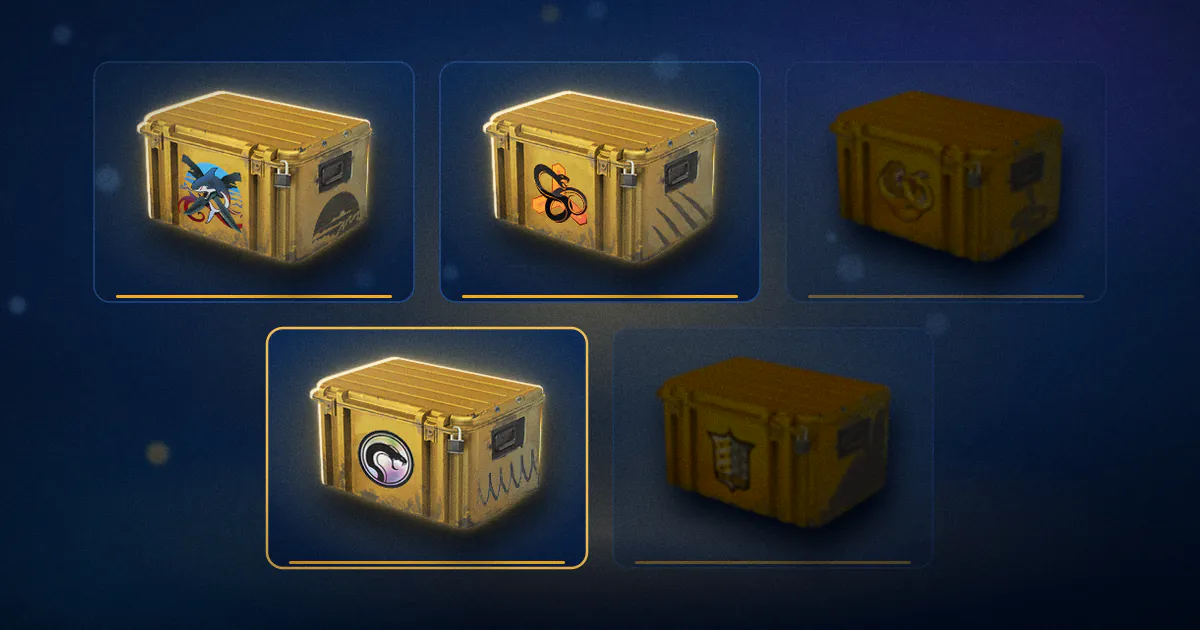
What is the CS2 case drop pool?
The CS2 case drop pool is the set of weapon cases that can drop as a reward from playing. Each week, the first time you rank up, you receive a weekly care package with a choice of drops, and cases are among the possible items. Which cases can appear is the drop pool. Valve adds new cases to it when they launch and removes old ones over time.
That pool is the main way new supply of a case enters the market. A case in the pool gets minted every week in large numbers. A case out of the pool is not minted at all; the only copies are the ones already in inventories and on the market. Since opening a case destroys it, the supply of a discontinued case only goes down.
That is the whole mechanism behind "case investing", and it is also why Valve's decisions about the pool move prices. This guide covers the mechanism, the two big changes of the last two years (the Armory and the removal of the rare drop pool), and the risks. Read are CS2 skins a good investment alongside it, because everything here sits on top of those risks.
How does a case's price change when it leaves the drop pool?
The typical path, drawn from how past cases have behaved:
| Stage | Supply | What tends to happen to price |
|---|---|---|
| New case in the pool | Growing fast | Low and falling as drops pile up; the case is cheap to open |
| Older case still in the pool | Growing steadily | Low and stable; most of these cases are near the minimum the market allows |
| Removed from the pool | Fixed, then shrinking | Starts low; rises slowly as openings eat supply, faster if demand for its skins or its knives grows |
| Years after removal | Much smaller | Can be many times the original price; behaves like a collectible |
The rise after removal is not automatic. It needs people to keep opening the case, which needs the skins or rare items inside to stay desirable, and it needs buyers who want to hold sealed cases. Cases with popular knives and a couple of famous skins have risen most. Cases with weak contents have risen slowly or stalled for years.
Two things cap the upside. First, at some price, opening the case stops making sense even for the knife chance, and openings slow, which slows the supply shrink. The drop rates tool and case simulator show what those odds look like. Second, Valve can change the rules at any time, as the rest of this guide shows.
What did the Armory change about case supply?
On 2 October 2024, Valve introduced the Armory, per the release notes. It is a paid pass that lets you earn Armory Credits by playing and redeem them for items, including cases. The Armory launched with "3 new weapon collections, 2 charm collections, 2 sticker collections, the Gallery Case, and the Heat Treated Desert Eagle".
The Armory created a new kind of case: one that never drops. The Gallery Case, and later the Fever Case added in the 31 March 2025 update, could only be obtained by redeeming Armory credits. Their supply was set by how many players chose to redeem them while they were offered.
Then Valve removed them on a schedule. The 10 September 2025 notes said "Last chance to pick up the Gallery Case, Graphic Collection, and Character Craft stickers from The Armory", and the 1 October 2025 notes confirmed they were removed. Once removed, an Armory case is in the same position as a discontinued drop case: fixed supply, only going down.
The same update that introduced the Armory added a rule that affects every case trader: "All items acquired from the in-game store (including the Armory), Trade Offers, and Steam Community Market are now subject to a 7 day re-trade and re-market restriction." A case you buy today cannot be relisted for a week.
For supply, the Armory means Valve now has two dials: what drops, and what is redeemable. Both change with updates, usually with a short warning for removals and none for additions.
What happened when the rare drop pool was removed?
For years, the weekly drop system had a small chance of giving an old, discontinued case instead of a current one. Community trackers put that chance at around 1% and called it the rare drop pool. It meant that legacy cases were never fully discontinued; a trickle of new copies kept arriving, which kept their prices from running away.
Around mid-December 2025, community data trackers reported that this trickle stopped. Their statistics showed no rare case drops after that point, and Valve did not mention the change in any release notes.
If the trackers are right, every legacy case went from "slowly refilled" to "truly fixed" at once. Prices of the affected cases rose in the weeks after, on the expectation of scarcity. Whether that rise holds depends on whether people keep opening those cases at higher prices and on whether Valve ever turns the trickle back on.
The lesson for holders is uncomfortable. The change that helped legacy case prices the most in years was silent, unconfirmed, and could be reversed just as silently.
How does the knife trade-up rule interact with case prices?
On 22 October 2025, Valve allowed five Covert skins to be traded up into a knife or gloves from one of their collections, per the release notes. That changed case prices through two routes.
Coverts became inputs. Every case's Covert skins gained a second use. Demand for Coverts rose, and so did the value of opening cases that contain desirable Coverts. That supports case prices, since a case is partly a ticket to its Covert slot.
Knives got a second source. A case's knife pool was no longer the only way to get those knives. Knife prices fell. Since the knife slot is a large part of a case's expected value, the value of opening most cases fell with it, which pulls the other way on case prices.
Which effect wins depends on the case: how good its Coverts are as trade-up inputs versus how much of its appeal was the knives. There is no general answer, and the market has been sorting it out since. What is certain is that a rule about trade-ups repriced cases overnight, which is the same lesson as the Armory and the rare pool: case prices are downstream of Valve's rules, and the rules move.
Why do some discontinued cases rise more than others?
The factors that separate the strong risers from the flat ones:
- The knives and gloves inside. A case whose rare items are popular finishes on popular knife types keeps getting opened by people chasing them.
- A famous skin or two. A case with a widely wanted Covert or Classified has a reason for people to keep opening it.
- How many were dropped. A case that was in the pool for years has an enormous supply that takes a long time to shrink. A case that dropped briefly has less.
- Whether it was a rare-pool case. Cases that received the rare-pool trickle had a slower shrink until December 2025. If the removal holds, they behave like the others from now on.
- Key price and opening cost. Opening a case costs the key too. As the case price rises, the total opening cost rises, and fewer people open, which slows the shrink.
- Attention. A case featured by a streamer or tied to a nostalgic era gets bought and opened more.
Community price histories show all of these at work, and they also show plenty of cases that had every apparent advantage and still stalled for years. If you want a single rule: cases rise when people keep opening them, and people keep opening them when the contents stay wanted.
What are the risks of holding cases?
Cases share every risk in are CS2 skins a good investment, and add a few of their own.
- Valve controls the supply and changes it without notice. The rare pool removal was silent. A reversal could be too. A legacy case added to the Armory would flood its supply.
- Value depends on opening demand, which is gambling demand. If fewer people open cases, because of regulation, a change in the game, or fashion, the shrink slows and the price case weakens. Our house edge guide explains why opening is a losing bet, and holders are relying on people making it anyway.
- You do not own them. Licensed, not sold, under the Subscriber Agreement.
- Slow and fee-heavy. Years of holding, then 5% plus 10% to sell on the Steam Market for wallet credit per the Community Market FAQ, or a marketplace fee and a cash discount. The trade profit calculator shows the round trip.
- Bulk is hard to exit. Hundreds of cases sell one at a time. Dumping them moves the price.
- 7-day locks. Cases you buy cannot be relisted for a week. Cases you receive by trade are Trade Protected for a week.
- Account risk. One hijack, one bad trade confirmation, and the whole stack is gone, with 7 days to reverse.
How would a careful person approach case supply changes?
If you are going to hold cases at all, this is what careful looks like.
- Only money you can lose and leave alone for years.
- Know why each case would be opened in the future. If you cannot name the knife or skin that will keep people opening it, do not hold it.
- Watch the release notes, every update. Every big move in this guide came from a release note or from a change Valve did not announce. Read them as they land and read the Armory section each time.
- Assume any supply rule can reverse. Size your holding so that a legacy case returning to the pool is a bad day, not a disaster.
- Calculate the exit with fees before you buy. Steam credit or cash, which venue, what fee, what discount.
- Keep them in your own secured inventory.
- Do not open them to "test" the odds. Opening is the losing side of the trade you are trying to be on the winning side of. The case simulator is free and uses real odds.
For the same story told through sticker capsules, including the 2026 switch to a Major Shop that removed capsules entirely, read how sticker capsules behave after Majors. Valve changed that format in one update. It can do the same to cases.