

What are the official CS2 case odds?
Every CS2 weapon case uses the same five odds, one for each rarity. Valve published them in 2017, when China required games to show loot box odds. The numbers still apply to CS2 weapon cases today.
| Rarity | Color | Chance | About 1 in |
|---|---|---|---|
| Mil-Spec | Blue | 79.92% | 1.25 |
| Restricted | Purple | 15.98% | 6 |
| Classified | Pink | 3.2% | 31 |
| Covert | Red | 0.64% | 156 |
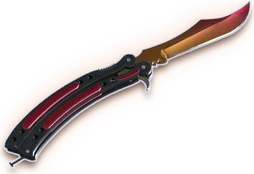
| Knife or gloves | Gold | 0.26% | 385 |
The five chances add up to exactly 100%. Every case you open lands in one of these tiers.
How do you read "1 in X cases"?
"1 in X" is the average gap between hits. It is 1 divided by the chance. A Covert at 0.64% works out to 1 in 156 cases.
It does not mean you get a Covert every 156 cases. It is an average over a very large number of openings. Some people hit two Coverts in 20 cases, and some open 500 without one. If you want the chance of at least one hit in a set number of cases, use the how many cases for a knife calculator.
Why is each tier about 5 times rarer?
Look at the chances side by side. 79.92% is 5 times 15.98%. 15.98% is about 5 times 3.2%. 3.2% is 5 times 0.64%. Only the last step is smaller: 0.64% is about 2.5 times 0.26%.
This pattern makes it easy to estimate by hand. For every 1,000 cases, you expect about 799 Mil-Spec, 160 Restricted, 32 Classified, 6.4 Covert and 2.6 knives or gloves on average.
How are odds split between items in the same rarity?
Valve publishes the odds per rarity, not per item. Inside a rarity, the common way to read it is that each item has an equal share. Our case simulator works this way, and the per-item table above uses the same rule.
So the chance of one exact skin depends on how many skins share its tier. Most modern cases have 7 Mil-Spec, 5 Restricted, 3 Classified and 2 Covert skins, plus a pool of knives or gloves. Use the case selector above to see the counts for any case.
Worked example: one Covert skin in a new case
Take a case with 2 Covert skins. The Covert chance is 0.64%, split between 2 skins. Each one has a 0.32% chance per case, or about 1 in 313.
Now take a single Mil-Spec skin in the same case. The Mil-Spec chance of 79.92% is split between 7 skins. Each one has about 11.42% per case, or about 1 in 9.
| Item | Tier chance | Items in tier | Chance each | About 1 in |
|---|---|---|---|---|
| One Mil-Spec skin | 79.92% | 7 | 11.42% | 9 |
| One Restricted skin | 15.98% | 5 | 3.20% | 31 |
| One Classified skin | 3.2% | 3 | 1.07% | 94 |
| One Covert skin | 0.64% | 2 | 0.32% | 313 |
Worked example: one exact knife
The gold tier is where the pool size matters most. Every case has the same 0.26% chance of a knife or gloves. But some cases have 13 items in that pool and others have 65.
With 13 items, one exact knife has a 0.02% chance per case, or 1 in 5,000. With 65 items, it is 0.004%, or 1 in 25,000. The table of all cases under the tool lists the pool size for each one. Our dataset counts each Doppler phase as its own item, so pools with Doppler knives look bigger.
Are the odds the same for every case?
The five rarity odds are the same for every weapon case. What changes between cases is the number of items in each tier, and which knives or gloves are in the rare pool.
Some older cases have fewer skins in a tier. When a tier has fewer items, each of those items is more likely. The tier chance stays the same.
Do these odds apply to case-opening websites?
No. These are the odds for opening a real case in CS2 with a key. Case-opening websites build their own cases and set their own odds for each item. Always check the odds a site shows for its own case. To learn how those sites keep a share of every bet, read house edge explained.
What about StatTrak and float?
StatTrak and float are rolled after the item is picked. Valve has not published the StatTrak chance. The widely cited community figure is 10%, and our simulator uses it as an estimate. Gloves never come as StatTrak.
Float is also not published as odds. Our simulator draws a float evenly inside each skin's real float range and labels it as simulated. You can check what any float means for wear with the float checker.
When should you use this page?
Use it as a quick reference when someone asks "what are the odds of a knife?" The answer is 0.26% per case, about 1 in 385. Use the case selector when you want the odds of one exact skin, and the table under the tool when you want to compare knife pools.
If you want to feel the odds rather than read them, open a few hundred cases for free in the case opening simulator. It uses these exact numbers.


