

What are the three unbox challenges?
Each challenge runs simulated case openings with the real CS2 drop odds and shows you what happened.
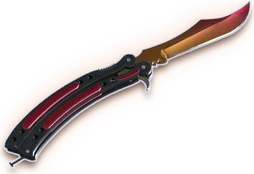
- Open until you hit a knife. The tool opens one case after another with a live counter until a knife or gloves drops. Then it shows how many cases it took and what those cases and keys would have cost at real prices.
- Best pull from 10 cases. Ten cases open at once and the tool picks your best item. Higher rarity wins, then StatTrak, then the lower float.
- Covert hunt. Like the knife challenge, but it stops at your first Covert skin (a red weapon skin). Knives and gloves do not count here.
Nothing costs money. Items are simulated, have no value and cannot be traded. Your best pull from each run is saved to your simulated inventory, so it also shows up in your collection book.
How many cases does it take to hit a knife?
A knife or gloves has a 0.26% chance per case. That is about 1 in 385. So the average run takes about 385 cases. But the average hides how wide the spread is.
| Cases needed | Knife or gloves | Covert skin |
|---|---|---|
| Average (1 ÷ chance) | 385 | 156 |
| Half of runs end by | 267 | 108 |
| 3 in 4 runs end by | 533 | 216 |
| 9 in 10 runs end by | 885 | 359 |
| 99 in 100 runs end by | 1,769 | 718 |
These numbers come straight from the published drop rates. The tool uses the same numbers, so your runs will match this table over time.
Why does the count vary so much?
Every case is a fresh roll. The game does not remember your last 300 cases, and a long dry run does not make the next case any luckier. This is called being "memoryless".
When each try has the same chance p and you stop at the first hit, the number of tries follows a geometric distribution. The chance your first hit comes on case number n is:
(1 - p)^(n - 1) × p
That is the chance of missing n - 1 times in a row, then hitting once. The chance of a hit within n cases is 1 - (1 - p)^n. The average is 1 ÷ p.
The shape of this curve is the key. The single most likely case for your knife is the very first one, but each case on its own is still very unlikely. The curve then falls away slowly, with a long tail. About 12% of knife runs end within 50 cases, while about 7% of runs pass 1,000 cases. Both are normal results of the same odds.
Because of that long tail, the average (385) is higher than the middle run (267). A few very long runs pull the average up.
Where does the cost come from?
Each real case needs a key, so the cost per case is the case price plus the key price. When you pick a case, its price starts at the Skinport lowest listing from our price snapshot, or the 7-day median sale if nothing was listed. The key starts at $2.49, the price of a key bought inside the game in USD. Valve shows that price only in the game, so our source is a secondary one. You can type over both numbers.
The cost only shows what the same number of cases would have cost. It is not the value of the item you got. A knife after 900 cases does not make that knife worth 900 keys.
Was a knife after 412 cases lucky?
Say your knife run on the Fever Case ends on case 412. The Fever Case had a Skinport lowest listing of $0.53 on 24 Sep 2026, so with a $2.49 key each case costs $3.02. Those cases would have cost 412 × $3.02 = $1,244.24.
Is that lucky? The chance of a hit within 412 cases is 1 - (1 - 0.0026)^412, about 66%. So 66% of runs finish this fast or faster, and this run was a bit slower than the middle. The tool calls a run "Lucky" when fewer than 25% of runs would finish that fast, and "Unlucky" when more than 75% would.
What is a good result from 10 cases?
Ten cases is a small sample. Here is what the published odds say about your best item from 10 cases.
| Best pull at least | Chance in 10 cases |
|---|---|
| Restricted | 89.4% |
| Classified | 34.2% |
| Covert | 8.6% |
| Knife or gloves | 2.6% |
So about 1 run in 10 is all Mil-Spec, and 2 runs out of 3 have nothing better than Restricted. A Covert in your best-of-10 is a roughly 1 in 12 result.
Are the odds boosted to make runs more fun?
No. Every opening uses the same code and the same drop rates as the case simulator. The tool shows the real spread, including the long boring runs.
When should you use the unbox challenges?
Use them to feel the odds instead of just reading them. Run the knife challenge ten times and compare your fewest cases with your average. Then use the case odds calculator to work out the chance for any number of cases you have in mind.
If you are thinking about opening real cases, read house edge explained and are CS2 skins a good investment first.


