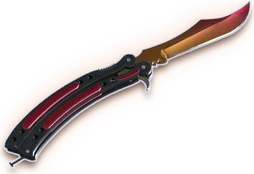


Well-Worn, shortened to WW, sits between Field-Tested and Battle-Scarred. A skin is Well-Worn when its float falls between 0.38 and 0.45. That is a window of only 0.07, the same width as Factory New, which makes Well-Worn copies scarce relative to Field-Tested and Battle-Scarred. Scarce does not mean valuable, though, since demand for heavily worn skins is low.
At this tier most finishes show heavy fading, bare metal on edges, and large scratched areas. On some skins the difference from Battle-Scarred is small.
Why is Well-Worn often priced strangely?
Because there are fewer Well-Worn copies than Field-Tested or Battle-Scarred, listings are thin, and the price can sit above a Battle-Scarred copy or below a Field-Tested one for no clear reason. Some buyers who want a cheap version of a skin skip straight to Battle-Scarred, and some skip Well-Worn because they assume it is the same look for more money. Check recent sales instead of the current lowest listing when pricing a Well-Worn skin.
A few finishes have a float cap that ends inside the Well-Worn range, so for those skins Well-Worn is the worst tier that exists and Battle-Scarred copies do not exist at all.
Is Well-Worn useful for trade-ups?
Well-Worn inputs are cheap and can be useful when the output skin has a low maximum float. The output float is the average of normalized input floats mapped onto the output's range, so a set of Well-Worn inputs can still produce a Field-Tested or even Minimal Wear output if the output skin caps out early. This is the core idea behind float capping. Run the numbers in a float cap calculator first, because for skins with a full 0 to 1 range, Well-Worn inputs return a Well-Worn output.