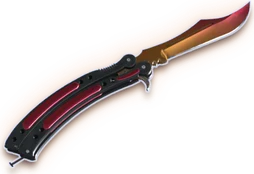


Battle-Scarred, shortened to BS, is the bottom of the five CS2 wear tiers. A skin is Battle-Scarred when its float falls between 0.45 and 1.00, the last of the five wear tiers listed in Valve's Weapon Finishes guide. The range covers more than half the float scale, so it holds a wide spread of looks. A copy at 0.46 is close to Well-Worn, while a copy at 0.99 may be worn back to almost bare metal.
Battle-Scarred copies are usually the cheapest version of a skin. For players who want a design without the price, Battle-Scarred is the way in, and some finishes such as dark or metallic ones hide wear well enough that the tier still looks fine in a match.
Why are some Battle-Scarred skins worth a lot?
High-float collecting. Just as low floats near 0.00 attract buyers, floats near 1.00 attract a smaller group who collect the most worn copies in existence. A skin with a float of 0.999 can sell far above a normal Battle-Scarred copy, because the community wiki and float checkers both report that floats at the very top of the scale are among the rarest rolled. Some skins also have a maximum float below 1.00, so the highest possible float for that finish becomes a rarity of its own.
Battle-Scarred versions of expensive items like knives and gloves can still cost a lot because the base item is expensive. A Battle-Scarred Karambit is cheaper than a Factory New one, but it is still a Karambit.
Do Battle-Scarred inputs ruin a trade-up?
Not always. Valve has not published the formula, but community testing shows the result's float comes from the average position of the input floats inside their own ranges, mapped onto the output skin's range. If the output skin has a low float cap, even Battle-Scarred inputs can produce a Field-Tested or Well-Worn result. For skins that span the full 0 to 1 range, Battle-Scarred inputs return a Battle-Scarred output. Traders who hunt very high float outputs sometimes do the reverse and feed in the highest floats they can find.