


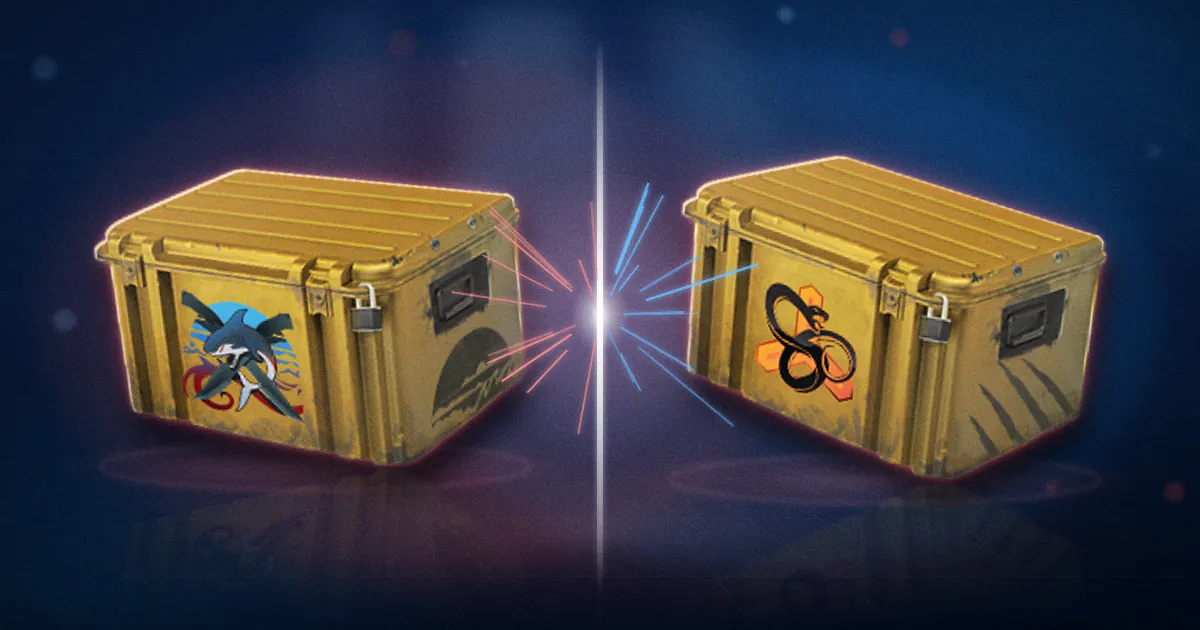
What is a case battle?
A case battle is a head-to-head version of case opening offered by third-party sites. Two or more players agree on a list of cases. Everyone pays for the same list. The cases are opened at the same time, one round per case. When the last round ends, the players' totals are compared, and the highest total wins every item opened by every player.
It is opening cases with a tournament bolted on. The opening part has the same odds and the same house edge as opening those cases alone on that site. The tournament part turns "I got a $5 skin" into "I got a $5 skin and lost it" or "I got a $5 skin and won $60 of other people's skins". Nothing about the average changes. The spread of outcomes gets much wider.
This guide explains how battles work, how the winner is decided, the common variants, and how to think about the risk. It does not recommend case battles. If you are considering them, read the house edge guide first and the responsible gaming page before you deposit anything.
How does a case battle work step by step?
The flow is nearly the same on every site.
- Someone creates a battle. They pick the cases, the number of rounds (one round per case, some cases can repeat), the number of players (2, 3, 4, or team formats), and the mode.
- The entry cost is the sum of the case prices. Three $5 cases is a $15 entry, per player. Every player pays the same.
- Other players join, or empty slots are filled with bots if the creator allows it.
- The rounds run. In each round, every player opens the same case. The results are shown side by side, usually with an animation.
- Totals are compared after the last round, using the site's own valuation of each item.
- The winner receives everything: their own items plus every other player's, credited to their site balance or inventory.
- Ties are resolved by the site's rule, which varies.
The case battle simulator runs this loop with real Valve-style odds so you can see how often a given entry wins and what a long run of battles looks like, without spending anything.
How is the winner of a case battle decided?
By total item value at the end, as priced by the site. Three details in that sentence matter.
Total, not best item. A player with one $100 pull and two $1 pulls beats a player with three $30 pulls. Round-by-round wins do not count; only the sum at the end.
As priced by the site. The site assigns a value to each item. That value decides the winner, and it may not match what the item sells for on the Steam Market or a marketplace. Valve's Community Market FAQ is a good place to check a real price, remembering its own 5% plus 10% fee comes off any sale there.
At the end. Battles are not decided until every round is opened. A big lead in round one can vanish in round three. That is by design; it keeps people watching.
Ties are the piece nobody reads until it happens. Splitting the pot is common. Some sites use the provably fair roll of the round as a tiebreak. Some run an extra round. A site's rules page tells you which, and you should know before you join, because a tie rule that hands the pot to a random player is a materially different bet from one that splits it.
What battle modes exist?
Sites have added variants on the basic format. The names differ by site, but the mechanics fall into a few groups.
| Mode | How the winner is chosen | What it changes |
|---|---|---|
| Standard | Highest total value wins everything | The baseline |
| Lowest wins (often called crazy or underdog) | Lowest total value wins everything | Rewards bad pulls; the maths is the same, the feeling is different |
| Team | Players split into teams, team totals compared, pot split among the winning team | Lower variance per player, smaller share of the pot |
| Shared or split pot | Pot divided by some rule instead of winner takes all | Lower variance; check the exact split |
| Group or jackpot | Many players, one winner | Very high variance |
In every mode, each case is opened with the same odds. The mode only changes how the results are pooled and divided afterwards. A mode cannot improve the average outcome, because the average is set by the case's item table and house edge. It can only move value between the players in the battle.
Is a case battle better or worse odds than opening cases alone?
The same, per case, and worse overall for most players.
Per case. The item table does not change because you are in a battle. Your chance of pulling each item in a given case is what it is. The house edge calculator gives you the expected return on that case, and it is the same in a battle.
Overall. In a fair two-player battle where both players face the same house edge, each player's expected return is still the case RTP times the entry, minus any extra cut the site takes from the pot. The average is unchanged or slightly worse. What changes is who gets it. Instead of every player losing a little, one player wins the pot and the others lose everything.
There is one wrinkle. Some players believe they gain an edge by picking opponents or by choosing cases whose value spread suits them. Against another human paying the same entry, no such edge exists; the roll is random for both. Against site-run bots, the question is whether the bot's pulls go back to the site, and that is a question for the site's fairness page, not something to assume.
The honest summary: a case battle does not improve your odds. It converts a steady, small expected loss into a lottery with the same expected loss and a much bigger spread.
How does variance change in a case battle?
A lot, and this is the part to understand before you play.
Take a $10 case with a 15% house edge, so an $8.50 expected return. Open it alone and your typical result is a small item, sometimes more. Your worst case is a near-worthless pull, and you keep it.
Now put that case in a two-player battle. Your entry is $10. Half the time, roughly, you win the pot: your item plus theirs, on average around $17. Half the time you get nothing. Your expected return is still about $8.50, but your outcomes are now "about $17" or "zero", instead of "about $8.50 give or take".
Add more rounds and more players and the spread grows. A four-player, five-round battle with $10 cases is a $50 entry where the usual result is losing $50 and the rare result is winning around $170. The average sits in the same place. The experience is completely different.
High variance feels exciting and is what makes battles popular. It is also what makes them dangerous for anyone chasing a loss, because a single win can look like the whole night's losses undone, and the next few battles quietly take it back. The case battle simulator is worth an hour with fake money before any real ones, just to feel how long losing streaks run.
How do you check a case battle is provably fair?
The same way as a single case, once per round. A provably fair site generates each player's roll in each round from a server seed, client seed and nonce, and reveals the server seed later so the rolls can be checked. The full mechanism is in how provably fair works.
For a battle, the things to confirm are:
- Each round's roll for each player is listed with the inputs needed to verify it.
- The same case uses the same item table for every player in the round.
- Bots' rolls are verifiable too, generated the same way as players'.
- The revealed seed matches the hash shown before the battle started.
Paste the values into the provably fair verifier for a couple of rounds, especially the decisive one. If a site does not provide per-round verification data, you cannot verify the battle, only trust it.
As always, provably fair proves the rolls were not altered. It does not prove the item table gives you a fair return, and it does not prove the site will pay out. Those are separate checks.
What should you know before joining a case battle?
A short list, in order of importance.
- The house edge on each case in the battle. Calculate it with the house edge calculator from the site's odds. That is your expected loss per battle, before any pot cut.
- Any additional cut on the pot. It is in the terms. It raises your expected loss.
- The tie rule.
- Whether bots are in the battle and how their pulls are handled.
- How items are valued and what it takes to withdraw a win as a real skin.
- Your limit for the session, set before the first battle and not moved afterwards.
- That you are old enough and the site is allowed where you live. Case battles are treated as gambling in many places.
A case battle is a bet with a known expected loss and a wide, exciting spread. Treat the entry as the price of the experience, expect to lose it, and stop when you reach the limit you set. If you find that you are not stopping, the responsible gaming page has tools and places to get help, and using them early is the smart move, not the weak one.